society

The very story of a ‘No’…

No-red

I recently heard some friends, uncomfortable, blaming themselves for having accepted a task they did not want to do. It was not the first time, they knew they would regret it, but they said yes and – guess what – felt upset about it. The question that came to me, straight, was : what would be the path for a light and illuminated ‘no’  ? A ‘no’ you would be comfortable with and would wear with a smile. Here is my fist take.

What are the conscious reasons why you would say no, in working situation, when you have the choice.

First. You don’t like the task – or you don’t like the person you would have to work with.

Second. You like the proposal, but you have other things to do, more urgent.

Third. You are neutral but don’t get any benefit for doing it.

Whatever. First, second, third. You should not be ashamed for any of those reasons. Cause you have the right to follow your own agenda. Working on things and with people you like, having a personal objective, or wanting to get a benefit from your work. Money, reward, fame, repeat after me, you have the right to expect something from the time you are spending working. So if you have the choice, saying no in one of those scenario, is highly recommended.

Fourth case, where you would say no. Your first intuition yells ‘SAAAAY NOOOOOOO‘ – and you don’t know exactly why. Do you have to decide ‘no’ ? I’d say yes. I mean yes, you should decide that you won’t do that. Because you have to trust your intuition – unless you are in a bear mood and you perfectly know your judgement is altered, in which case, you should defer your decision. But in normal situation, your brain is able to analyze a situation in a heartbeat and give a diagnostic : shitty situation, beware danger, really don’t feel it, never ending story coming, unreachable goal…You usually feel it. Unless the request is coming from an unknown person, on an unknown topic for an unknown deliverable. In that case you should decide either that you are not the right person to do that stuff (which means say no), or you should request additional information, delay your answer, in order to have all those clear and known.

Now that you understand the reason(s) why you want to say no, between you, yourself and your brain, the next question is.

Do you have to tell the people that your final decision is no ?

I guess it depends. I am the kind of person saying no and explaining why. A one sentence answer, with enough details to make sure I am understood (and not hated), and keeping for myself the backstage stuff, the various pro and cons. But I recently had a cool conversation with a friend of mine (@valvert) and he suggested that sometimes, when you are in a specific dynamic, with limited resources and managing important challenges (yes, that guy is organizing e-commerce events and need to deploy a-lot-of-energy), in that special case, stopping a second to tell ‘no’ to someone has some disadvantages : you loose your time and energy, breaking your positive dynamic, and eventually, you loose a chance to have that person subscribing to your own project and vision. That is a story I can understand.

There may have other strategies and I am curious to know yours ! In the end, each of us has to find its own method, depending on its energy, communication skills, ability in conflict management and mood.

Why is it important to understand the very story of a “no” ? Because understanding your decision (I am not going to do that because that guy puts on knees anyone working with him) and identifying what will be your explicit answer (dropping an email saying that you are too busy to spend energy on that project) makes you stronger. Then, you are confident that your decision was not a caprice. You made an explicit choice that will be easier to defend, if required. In addition, if any of the decision making parameters change, you will be able to change your mind with no friction. All benefits for you !

An aside question came to me when I wrote that post : how do we learn in our society to say no ? As a french girl, going at school, I don’t remember when I was taught how to say no. I had some kind parents, taking time to explain me the life, the good, the bad, (well, their version of it, that I later amended). As an adult, I still have the feeling that saying no is an offense. Thus. The real open question to me stands in when are we able to construct our “no” skills. A next post may deal with that…

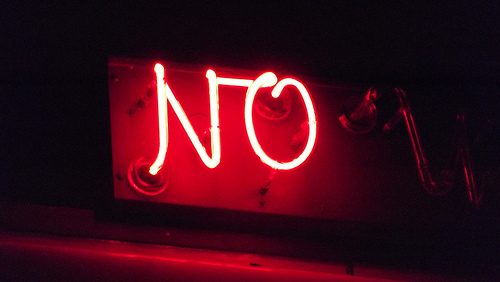
Note : picture from http://imgarcade.com/1/red-neon-signs-tumblr

Speakeuse à #shake16 : une expérience !

TL;DR – cette semaine, j’ai passé deux jours à Aix en Provence à l’occasion de #shake16, et c’était cool.

shake16

La conférence Shake c’est un rendez-vous pour les professionnels du e-commerce. La formule est excellente : un mixte de conférences plénières avec les grands du business sur le web (la Poste, Price Minister, Facebook, nan, mais il y en a trop, regardez la liste); des ateliers pointus avec les pro; des stands pour les éditeurs, asso et gens créatifs; des  podium de startups; et des rendez-vous d’affaire (pas moins de 500, de quoi signer des deals ou nouer de belles relations).

Le thème du e-commerce est évidemment passionnant et propice à se décliner sous différents angles : la transformation numérique, la transformation du travail, le rôle de la technologie dans nos vies, les problèmes de logistique, de magasin physique, virtuel, de cross-canal et omni-client (ou l’inverse). Cette année l’accent était mis sur le Pourquoi (pourquoi est-on entrepreneur, e-commercant …) et la relation client, qui se doit au XXIème siècle, d’être bienveillante, bichonnée, respectueuse, pertinente. Bref, #shake16 était une belle promesse pour les visiteurs et les visiteuses.

Et cette année, j’étais speakeuse. Ouaip, la classe (merci à Hervé Bourdon et Jacques Froissant de m’avoir fait confiance). Mais être speakeuse à Shake cette annnée, c’était pas *que* la classe. C’était aussi une expérience toute particulière. Pourquoi ? Parceque l’esprit de Shake (entre autres choses) et de donner et partager, de rouler sur l’énergie de la communauté. Et la team de Shake a fait le choix de traiter les personnes présentes sur les stands (help sémantique, des standistes ?) et les speakers comme des *utilisateurs* de l’événément. Nous étions donc des accompagnés, avec bienveillance. Et ça a fonctionné du tonnerre.

Pourquoi c’était si spécial ? Parceque les speakers et les standistes, en plus des petit fours et de la salle de repos, avaient accès à un boostcamp d’une demi-journée, organisée par Marie Aurélie, avec l’aide de gentils accompagnateurs avec un programme très enrichissant. Voyez-donc.

Dans un premier temps, assemblés par groupe de 6, nous avons eu la chance de nous détendre avec un escape game taillé sur mesure (le code pour sortir, c’etait 176, sachez-le).

Ensuite nous avons passé du temps avec des professionnels de la relation, de l’entreprise et du corps. L’équipe 5, la mienne, encadrée par la fantastique Delphine Foviaux, a suivi le programme suivant  :

  • un atelier sur le marketing emotionnel avec Patrice Laubignat. Absolument éclairant pour revisiter sa relation à l’autre, le regard que l’on porte sur soi et sur ses interlocuteurs, pour enterrer les peurs qui freinent les échanges libres et fructueux.
  •  une dose d’entreprise libéré avec Nicolas Trossat. Ici, on apprenait les clés pour penser autrement le travail, avec des notions de  responsabilité collective, de transparence et de confiance. Un shoot d’utopie qui permettait de repenser sa relation au travail.
  • et pour finir, avec Daria Kucevalova, nous avons chanté (mal, mais on s’en foutait, c’était harmonieux). On a joué de la voix et du corps. Il s’agissait donc d’un exercice, ancré dans le présent et le sol, et qui permettait indéniablement de libérer quelques tensions.

A la fin de la journée de préparation, nous étions détendus, un peu soudés, un peu amis, et prêts à donner le meilleur de nous même sur les stands et la scène. Voilà, ça n’était pas que de l’amusement. Shake nous a donné les moyens d’être plus à l’aise et meilleur, de tirer profit de notre présence et de participer à l’énergie (déjà impressionnante) de cet événement. C’était sympa et généreux, suffisament rare pour le soulignere, et le faire savoir au reste du monde.

D’année en année, Shake grandit, et on a grande hâte d’assister à la prochaine édition #shake17.

Note : d’autres que moi disent que shake16 était fantastique, visitez donc

  • le blog du coach Will Roy là,
  • ou celui de biz200 pour un rapport business ici ,
  • ou encore chez Patrice Laubignat pour une vue émotionnelle là ,
  • chez Annie Lichtner et My Digital Week pour un point de vu pro du e-commerce
  • ou enfin sur le blog de Shake ou Marie Aurélie partage sa vision du boostcamp
  • du côté de chez Henri Kaufman pour grappiller les bonnes idées en deux épisodes : un, deux
  • la vision de Pierre, qui était aussi dans l’équipe 5, de chez Web et Solution, sponsor de l’événement ici
  • et l’angle de Mélanie Pin, de Primasee, en charge de la mise en scène et des vidéo
  • Marie Aurélie, encore, mais cette fois avec sa casquette de psy, qui explore la question du pourquoi ici
  • le tour photo et impression rapide de Seb
  • et pour vous donner envie d’y aller l’année prochaine, la vidéo sumup de primasee
  • ou encore la story de #shake par ses deux fondateurs


W3C Advisory Board : job description !

ab job goup

W3C Advisory Board. What is the job, in the end ?
Well, being an advisor is about advising. The structure of W3C is a “benevolent” dictatorship. The director, Tim Berners-Lee takes any final decision,  taking advice from W3C team (73 people including 13 managers, 1 CEO) and from the W3C AB. It happens that the CEO, Jeff Jaffe, is also chairing the W3C AB, which makes the W3C AB advice landing in the right place.

In the last two years. As an elected W3C AB member, I had the pleasure to work in team on a large range of exciting topics.
– Organizing the conversation with members during the membership meeting, by setting up agenda, making sure important questions are echoed in the AB conversations,
– Helping with formal objection (with more then 400 members, unanimity is scarce) on accessibility strategy, content protection (aka EME, aka smells like DRM but is not DRM), creation of new group on hardware security…
– Process improvement, while the work is handled publicly by the W3C Process CG, AB supports it,
– HTML5 next steps, new features and WHATWG relations,
– New election voting rules with transferable vote (instead of voting for 5 people, you rank them, from your favorite to the less appealing and the magic helps to better balance the bias of champions, see @chaals from Yandex, for long beer conversations about it),
– Improving specification maintenance and good practice for creating new work in w3c (make sure W3C resources are well used for appropriate topics),
– Thinking about merging International Digital Publishing Forum and W3C for the sake of the EPUB format (see today’s announcement),
– Improving security W3C strategy, by supporting a clear security roadmap, with high visibility,
– Chair and editors community maintenance, making sure they get trained and heard, benefiting from modern tooling (aka Github for all, when possible),
– Synchronization with the W3C Technical Architecture Group (such fruitful conversations with the real architects of the web).

People knowing guessed that I put some special efforts on the security, consistency and community aspects. I think that the team progressed well and won, during the two years, ears from the W3C director, and positive feedback from the membership. I enjoyed it. And I believe I have influenced in a fair and objective way AB discussions, helping keeping good spirit and direction in the AB. That is the reason why I am jumping again in this W3C AB election. To get a seat and help the web 🙂

Another W3C Advisory Board mandate ? yes, sure !

IMG_20150606_165130

Here we are. After 2 years enjoying W3C Advisory Board discussions, it is now time to renew or not my seat. And I have decided to follow up on that experience. Dealing with such fantastic topics as W3C governance, priority and conflict resolution was a super experience. I enjoyed sharing with other team members, suggesting directions and finding what would be best for members and the open web platform. And I think we did well with the AB members in the last years…

The ballot is open, there are 6 candidates, for 5 seats. And votes are made by each of the 410 members of W3. The other candidates for that election are Tantek Çelik (Mozilla), Daniel Glazman (Disruptive Innovations), Jay  Kishigami (NTT), David Singer (Apple), Léonie Watson (The Paciello Group). Nominations can be read here https://www.w3.org/2016/05/02-ab-nominations

Oh ! And if you support my presence in the W3C Advisory Board, don’t hesitate to tell your W3C representative !


Tech, Web and Society in W3C

Blowball II - M.C. Escher

It has been several years I have been involved in W3C.The ten thousands of hours of discussions I had with some of my W3C colleagues, mates, folks, peers, were deadly interesting. We were covering the technical web, but all the stuff coming with it. The web and the society. The technology as a tool, that anyone can handle and use, following its own rules, follow its own goal. We discussed about the reliable and equal web. But. What does it mean to maintain a reliable web, for all ? What does it mean when a group of people decides to develop technologies to break it ? What does it mean to break the web ? You know, all those questions that do not directly fall in the basket of W3C – after all, it is only a technical standardization body ! Since one year, I was convinced that this was  a missing dimension in W3C. And something happened. Slowly by slowly, this idea came on the table. Why not creating a place for the W3C members to exchange on the potential impact of the technology developed in W3C ? Why not keeping an eye on the way the web is used today, and debate on the potential impact on policies ?

The Advisory Board and the W3C team have been working on the creation of the Technology & Policy Interest Group. A group which will be open to W3C members, a group which will gather state of the art on topics such as deep linking (or can we forbid to reference a resource), DMCA-like challenges (or how to allow researcher to stay on the legal side, while researching on the web, and thus potentially hacking it) and Surveillance (you know, government and companies monitoring all and everything). And this is, as a starter. The Tech & Pol  Interest Group, chaired by Jean François Abramatic, ex W3C CEO, will work in a W3C-member-only mode and will deliver some Analysis. Analysis is a new format, to avoid saying the group will deliver Note or normative Recommendation. First, those Analysis may be only a collection of problem, a list of solutions, and it will be up to the directors, with members consultation to do something from that.

That Interest Group is a fantastic chance to have a place to discuss those important topics, to have the craftsmen and craftswomen of the web, exchanging on technology impact, all together, and potentially raising the question on which type of web we want for all.

The creation of the Interest Group depends on the support it will gain in the W3C membership, and on the number of objection its review will collect. So, if you think this group is a good idea, and if your company is W3C member, I can only encourage you to ping your AC rep and tell him/her what you think…


Illustration: Blowball II – M.C. Escher


Ladies, go for cool networking !

keep-calm-and-have-some-drink-after-work.jpg

In the series of actions I find key for addressing my constant wish to learn and have a rich professional life, I have been trying to keep an always ongoing activity which is about “meeting humans”. Working in tech is great, being productive is great, but having a drink with smart people is even cooler. And, going further, having a passionate discussion with someone you don’t know yet, sharing vision and skills, is gold. Among other additional things, I am encouraging women to do so, because this is a smooth way to learn a lot.

It has been several years that I am now canvassing locally, entering different networks, keeping contacts, attending after work sessions. This is not only because I have decided to test my resistance to alcohol. This is because I believe the people I meet there, help me to grow up and they can benefit from my own experience.

So what do I mean by cool networking ? I am not talking about networking for selling product and services. I am talking about something that would happen in addition to your normal work. A networking where your income does not rely on. A networking where you do not expect anything – yet, except enjoying sharing. This is what I call “cool networking”. There are different criteria that I have experienced, that do work quite well for that expectation.

Spirit. I have decided to invest my time in networks which I have respect for and no fear. I mean, leveraging values I appreciate, because there is nothing like having a conversation with people with whom you have some common important values. My criteria are collaborative, openness, and direct talks. You might have yours, this is just an example.

Location. Taking care of a network means being there, not just *thinking* about it. And to be pragmatic, for cost and time reasons, you should go local. Meetup, association, forum, specific events. Try all of these. And if there is no network around you, just create it ! There are always means to identify people in your location that seems to be creative and dynamic (I use Twitter a lot for that). Find them and just get  organized !

Freedom. Entering a tribe is good if you don’t have to report every other morning why you were not here at the last meeting, and why is that you did not prepare a tomato tart for the recent joint dinner. Cool networking – as I suggest to maintain – is about being comfortable with others, and not being judged. So participating whenever I can, and just keeping track of the community remotely when I really can’t be there is what I call cool networking.

Gap. I want to meet people from whom I can learn something. Meeting people with the same-job-same-age-same-book-reading would be interesting, but not enough maybe that I spend an evening with this tribe rather then being with my friends and family.

In the end, my top list of tribes I belong to at the moment are Girls In Tech Marseille and #LittleFrenchTech, I am also ‘god-mothering’ for girls belonging to Duchess France, as I think it is a cool idea. All of this is taking few evening a month, but it is worth doing, as I met some fantastic people around it. Some are friends, now, some can help me in my job, some others I help … This has definitely enriched my social life.

It’s your turn now to experience cool networking and see how it goes…


Girls, be a man (for five seconds)

Still working on the idea of how it is to be a girl in tech – as opposed to a boy in tech. And I recently realized that one of my trick to find my way, and the right attitude in that ecosystem, dominated by men, was to actually ‘think like a man’. This is what I am doing when I am facing a decision making balancing private and professional life, or when I need to think my relation to the power, ask something to someone – specially when it is a man.

Let me explain, with a little exercise.

You have a agenda conflict, between an important meeting and the party of a relative. Whatever is your decision, before announcing it to the people you decided not to honour with your presence, put yourself in the shoes of a man you like. Let’s call that man, Roger. Roger has to be someone you respect, someone you believe has the right behavior at work or in private, someone you believe is balanced and fair with others. Note : if you feel that you are usually too sweet, you can try to find your Roger into the large fleet of assholes you meet everyday, but this is only recommended for benchmark purpose. So, you have your Roger. Now, try during 5 seconds to think the way he would handle the situation. And think what is the gap between your natural way to announce you will not be present to the party/meeting/wedding…

I don’t know how would react your Roger. But my Roger would say : “Look, I am sorry honey/boss/colleague/lover/grandma but I can’t make it. Another day would be more appropriate for me”. Dot. Dot. And not “I-am-telling-you-everything-about-my-woman-mother-life”. This trick is working very well in various situations. You are requested by MissesPerferctMother to prepare some cakes for you kid’s school party (and you can’t or you don’t want). You don’t want to have lunch with your colleagues, cause you wanna be alone. You want to go out and have several mojitos with your friends instead of staying at home (and now you love me, because your life is going to change)…

Disclaimer one. This trick is a trick. You should not become Roger (or marry him, or whatever). This is just a mimetic exercise to help you to change your mindset, try to endorse a man attitude. Measure the gap. But you will have to find your own style in the end.

Disclaimer two. This post is not about demonstrating how bad men are. This post is about demonstrating that you guys, have a terrific relaxing way to manage priorities and make your point. And that girls should learn from you.

Disclaimer three. Some men told me that they were actually heavy at work, claiming that they were proud to be father and put high priority on their family and leisure. Thus they felt my post was not relevant. I would say that only few of them can dare to do that, and bravo ! (maybe they had a female version of Roger…).

Disclaimer four. This post talks about ‘girl’ at work. Amy commented why she prefers to be named woman (or dame, or lady). And I think she is right. I can only encourage you to read her view below.

Now, ladies, choose your(s) Roger(s), and let me know how it feels..


Girls, promote your success

Dolores_peacock_(cropped)

Dolores peacock costume


Few months ago I wrote some thoughts I felt important to share with girls in tech. It was about killing usual culture, that refrains some girls (but also boys), from being free and natural at work, like feeling miserable or sorry for no reason. I now realize that part of girls (and boys) success in tech, is also about promoting correctly their achievement, realization, contribution. This may be a general worker problem, not a gender problem, but it seems to me that girls tend to forget more that special part of our job : promoting our success. This stroke me when I heard a colleague of mine commenting after a presentation I gave on a successful project ‘Well, Virginie, wonderful, that was clear and understandable, as usual, thanks you so much’. I did not have the feeling that I was outstanding, I just made my job. But I just got from that remark that promoting my work was beneficial for me and for the project. But the key is to do it efficiently.

What does it mean to promote efficiently ? It means building a message, adapted to your audience. A message, that will not get them lost, and overload them with inappropriate details. Of course it depends on the context, audience, and topic. Working on technology innovation scouting, meeting lots of people and companies and having to report different aspects, from market to strategy and technology, I had to think about my own classification on what to say to whom, and when. That classification might not be universal, but you can get the principles, depending on the context. Here it is.

But first. Never ever. Whatever is the situation, never ever get into the direction of sexist joke and naked girls (or boys), footbalistic analogy, Apple and Google systematic reference. This is forbidden – if your plan is to stay credible. While this may be the easiest way to have people with you, this is simplistic. And by avoiding reproducing that simplistic view of the world, you do not really miss anything, you just show you worth more then that.

Jump on opportunities. You meet the right person in the corridor, you need her or his advice, don’t miss it. Target one sentence and one smile. That is teasing time. You’ll have to say what is stake, which solution you believe you should go and make your request. Then smile and be silent to get an answer. Note for weird people : I am not talking about hot seduction attitude here, but just staying tuned, kindly.

The people agreed to meet you and you have time. It’s serious stuff, here, you are consuming time from some people. They have to know why you are here, what you are talking about. And to do so, I recommend to stay high level, talk strategy, express the key notions, expose the frictions, list the market actors and suggest solutions. And, because, you need to keep them happy with you, you can make jokes (aka, be relax and smart, alright, not making bad bar jokes). You must keep some time for concluding, making sure everyone agrees on the solution (action plan, next steps, …). That is normal communication rule. But (and that is the key point). During all this interaction. You should say ‘we’, when it was a team work and say ‘I’, when it was your own work. Don’t dilute your contribution, be transparent-cristal-clear about it. That is key to value your work.

You are on stage, in a conference. You may not have anything to learn from me if you already made the decision to be on stage. The only recommendation I would give is : build your talk like a story. You need a ‘fil rouge’, you need little anecdotes, you need surprise (taddaaaaaa, here is my program, wouaou, here is my design…). For the others. And if you are just thinking about applying for a conference talk, I would say that you should not hesitate anymore. Conferences are key event to force you to be synthetic and clear. This will give positive visibility to your project. And conference organizer will make their best to help you to be good on stage (it is their interest). Finally, you will be able to re-use your talk elsewhere. You just need to find the right conference, with the right audience.

You need to talk about your work, but... I know you want everyone to know that while going go from SuperProduct v1.3 to HyperProduct v1.4, you made some choices, you managed some shit, you were about to be killed by 2 engineers, and had to dance with your enemy, but… lets admit that, sharing those details in a decision meeting, or while reporting about your project success will not help you. You are professional, you are managing correctly your tasks and making decisions. That is why you are getting paid. But the good news is that you will have to leave evidence of your work. Digital archive, for voluntary and curious colleagues, or to have it somewhere for later reference. In this archive, you can play with all the secret details of your work. You can use your every days professional life vocabulary and habits. Acronyms, architecture, references to geek literature, bugs number, product version, test suite, clickable urls, little stories of your battles, multi-bullet points slides, matrix (with titles), text with different policies for super cool effects, resource planning, exhaustive list of participants, detailed figures… And this is the only place where you should play that game of entering into the boring details. Right ? Unless someone weird ask you detailed questions about it…

My 2 cents, hoping it will make you going out and showing your technical work to the world…

#shake15 : to VC or not VC

In the run of #shake15 conference, I attended a great presentation on venture capitalist myth and reality. The experienced entrepreneurs presenting, Michel Athenour (multiple founder) and Christophe Raynaud (VC ISAI director) made a great team show, spread with humor, irony and valuable real life experience. For people not familiar with the french VC landscape, you should know that France VCs invests 8.7 reasonable billions of euro in 2014, and is made of several tenth of VCs firms, with a recent increase of players.

The tone was quickly given by those (smart) guys. VCs are scarce.

And you should talk to them only in specific situation. When you are in hyper-growth and terrific expansion, when you are rich enough to pay your team salaries during 6 months (at least), when your team is balanced and great (this is one of the assets VCs will weight careful). If you can’t tick each of those boxes, try something else. Love money (your friend, lover, father, crazy uncle). If you tick all the boxes and wanna go VC, be ready to suffer. The mission of VC is about investing, giving money. Thus, they need to check few things, they need to trust you, your business model, your potential. And they will be looking for your weaknesses, asking the questions you dont want to hear, opposing competition you did not foresee… this torture will be iterative. Meet, talk, present, again. It may take you 3 months, long 3 months where you business will have to rock anyway. So provisioning energy and money for that specific period is a must. That was for the general aspects on when to go VC or not.

In addition Michel and Christophe shared some common sense tips for going VC.

Build your network in the VC jungle. You must have friends there, and it is normal usage to sanity check their reputation, identifying bad sharks and loosers (dont feel ashame, they will do the same for you and your team).

Be prepared to present your activity. This means training, working your presenting and convincing skills.

Think instead of VC. What is it that they want ? Make sure they can make money by reselling your activity. Look for your next acquirer, who will buy you soon, and tell them.

Accept that VC is not for all. And not successing when going, or not going is not a failure. This is just being reasonnable and playing in the relevant category. Again the press is puting a lot of emphasis on champagne, “paillettes” and successful fundings but this does not represent the average entrepreneurship story.

Thanks again to Michel and Christophe for this fruitful workshop !

Note1 : for more information on french landscape, download the AFIC report [PDF] or read recent Rude Baguette analysis .

Note2 : #shake15 learning related to e-commerce is also available here.

#shake15 : And now, all of us are shaking our digital commerce !

logo-shake15#shake15. Two days of e-commerce.

In one of the most prestigious place of Marseille, during 2 days, around 1000 people gathered and exchanged. Two days spent looking at merchants, staring at users, analyzing in-shop behavior and on-line habits, qualifying e-merchants and market place tribes. This is Shake event. So what can we learn by gathering all the actors of the value chain during 2 days ?

The consumer journey is multiple.

And it is not relevant anymore to even mention the opposition of online/in-shop, mobile/PC, in-shop / home delivery, before/during/after transaction time, web site/mobile application… A transaction has several touch points that no merchant can force or predict. Users are crazy. Let’s admit that, you need to be with him everywhere, anytime, with persistence. Admit that or you will miss it. Your next 2 years challenge is to build a consistent digital strategy allowing all combined path.

Facing such an asset, it makes no choice on today’s merchants.

You need to go digital, in a consistent way. If you are not convinced you should go, let’s have a look at the figures. E-commerce is generating 57 billions today worldwide. In France, the transactions have increased by 13,7 % on 2015 first semester. Buying on e-commerce site happens to users once every 15 days, average, with an always average price increasing. E-commerce is getting common to the 76 % French people connected. Finally, number of websites have increased by 14% compared to last year, leading to 160 000 active sites. You competitor may be among those ones. You can check the FEVAD figures to know more about that.

Few remarkable trends

You don’t need to be a pure player to go digital. Look at the recent move from CDiscount going Casino, eBay associating with merchants.

Usage of mobile application is important because it is the way to create a privileged relation with your customer, identifying him accurately, and analyzing his navigation in the application. This would allow merchant also to get benefit from the search results in Google search (also named as app-indexation).

Shops and employees in shop are getting transformed. Vendors work with devices, shops can offer picking services, shops can produce on demand and on-site thanks to 3D printing. Welcome to the new world !

Ads can now be served thanks to social media stream. The Twitter sponsor tweet, Facebook sponsored push are now some channels to be used. Just use it, they are convenient and annoys less the users.

And always. Mobile first mindset and geo-location usage can help.

Things to improve.

The pain point in e-commerce is still the payment. The payment, yes. Fragmentation in payment solutions, applications and user experiences is not good for the business. Specially the fact that there is no well known and standard experience reduces the transformation rate when finalizing the transaction. User needs to feel comfortable to press the final button. Something to improve…

Thanks #shake15

The panoramic vision offered by shake15 on trends and vision was really precious. Big-up to Hervé Bourdon and Jacques Froissant and the supporting team for setting up such event.

Note : Last year Shake edition can be found there https://poulpita.com/2014/06/30/shaking-marseille-e-commerce/

IMG_-y73910